
 E-submission
Search
- Page Path
- HOME > Search
Original Articles
- Characterization of undifferentiated carcinoma of the salivary gland: clinicopathological and immunohistochemical analyses in comparison with lymphoepithelial carcinoma
- Sangjoon Choi, Gyuheon Choi, Hee Jin Lee, Joon Seon Song, Yoon Se Lee, Seung-Ho Choi, Kyung-Ja Cho
- J Pathol Transl Med. 2025;59(6):361-370. Published online September 8, 2025
- DOI: https://doi.org/10.4132/jptm.2025.07.07

- 6,243 View
- 324 Download
-
 Abstract
 PDF
PDF - Background
This study aimed to reclassify a subset of poorly differentiated salivary gland carcinoma that do not conform to any entities of the current World Health Organization (WHO) classification into the category of undifferentiated carcinoma (UDC) because they lack specific histologic differentiation or immunophenotype. Methods: Cases of salivary gland carcinomas from Asan Medical Center (2002–2020) that did not fit any existing WHO classification criteria and were diagnosed as poorly differentiated carcinoma, high-grade carcinoma, or UDC, were retrospectively reviewed. Immunohistochemical (IHC) staining for p40, neuroendocrine markers, androgen receptor (AR), and gross cystic disease fluid protein 15 (GCDFP-15) and Epstein-Barr virus (EBV) in situ hybridization (ISH) were performed. Clinical data were collected from the electronic medical records. Results: Six salivary gland carcinomas did not align with any specific entities and lacked distinct differentiation. Two of six cases displayed lymphoepithelial carcinoma (LEC)-like morphology but were negative or showed negligible immunoreactivity for p40 and EBV ISH, distinguishing them from LEC of the salivary gland. Two cases showed strong AR positivity, suggesting a potential overlap with salivary duct carcinoma (SDC) but lacked classic SDC morphologies and GCDFP-15 expression. No cases expressed neuroendocrine markers. Conclusions: This study proposes reclassifying these poorly differentiated or high-grade salivary gland carcinomas as UDC based on their indeterminate differentiation and IHC profiles. This may lead to a clearer diagnostic category and enhance our understanding of these high-grade tumors.
- Primary Merkel cell carcinoma of the salivary gland: a clinicopathologic study of four cases with a review of literature
- Gyuheon Choi, Joon Seon Song, Hee Jin Lee, Gi Hwan Kim, Young Ho Jung, Yoon Se Lee, Kyung-Ja Cho
- J Pathol Transl Med. 2025;59(3):171-179. Published online April 30, 2025
- DOI: https://doi.org/10.4132/jptm.2025.03.25
- 6,270 View
- 173 Download
- 1 Crossref
-
Abstract
PDF
- Background
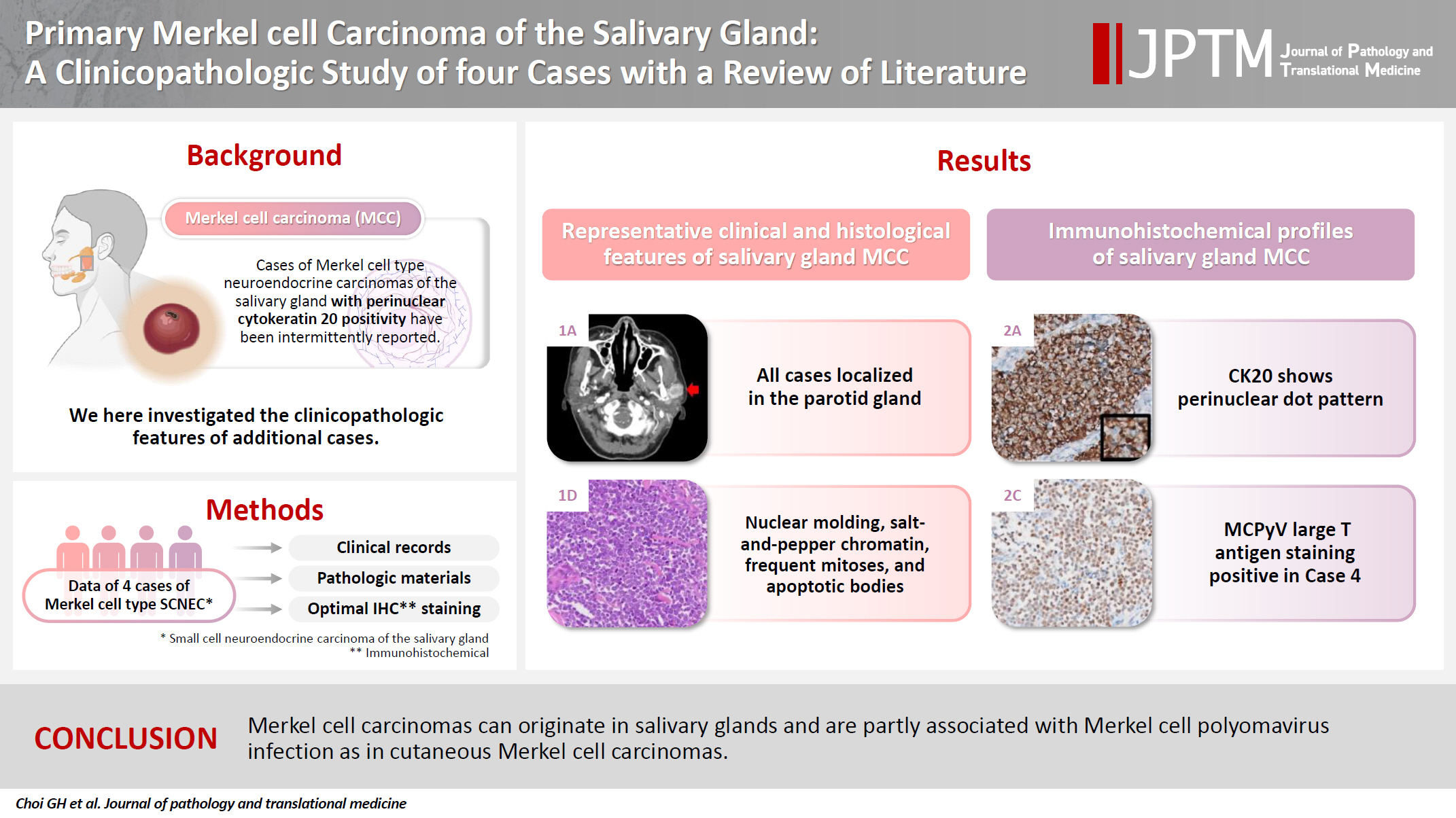
Primary Merkel cell carcinoma of the salivary gland is currently not listed in the World Health Organization classification. However, cases of Merkel cell type neuroendocrine carcinomas of the salivary gland with perinuclear cytokeratin 20 positivity have been intermittently reported. We here investigated the clinicopathologic features of additional cases.
Methods
Data of four cases of Merkel cell type small cell neuroendocrine carcinoma of the salivary gland were retrieved. To confirm the tumors’ primary nature, clinical records and pathologic materials were reviewed. Optimal immunohistochemical staining was performed to support the diagnosis.
Results
All tumors were located in the parotid gland. Possibilities of metastasis were excluded in all cases through a meticulous clinicopathological review. Tumor histology was consistent with the diagnosis of small cell neuroendocrine carcinoma. Tumors’ immunohistochemical phenotypes were consistent with Merkel cell carcinoma, including Merkel cell polyomavirus large T antigen positivity in two of the four cases.
Conclusions
Merkel cell carcinomas can originate in salivary glands and are partly associated with Merkel cell polyomavirus infection as in cutaneous Merkel cell carcinomas. -
Citations
Citations to this article as recorded by
- Parotid intranodal metastasis of Merkel cell carcinoma: a rare case report
Tong Gao, Dengshun Wang, Hongwei Yu, Yu’e Wang, Haibin Lu
BMC Oral Health.2025;[Epub] CrossRef
- Parotid intranodal metastasis of Merkel cell carcinoma: a rare case report
- Comparison of Squamous Cell Carcinoma of the Tongue between Young and Old Patients
- Gyuheon Choi, Joon Seon Song, Seung-Ho Choi, Soon Yuhl Nam, Sang Yoon Kim, Jong-Lyel Roh, Bu-Kyu Lee, Kyung-Ja Cho
- J Pathol Transl Med. 2019;53(6):369-377. Published online October 11, 2019
- DOI: https://doi.org/10.4132/jptm.2019.09.16

- 10,064 View
- 196 Download
- 9 Web of Science
- 13 Crossref
-
Abstract
PDF
 Supplementary Material
 - Background
The worldwide incidence of squamous cell carcinoma of the tongue (SCCOT) in young patients has been increasing. We investigated clinicopathologic features of this unique population and compared them with those of SCCOT in the elderly to delineate its pathogenesis.
Methods
We compared clinicopathological parameters between patients under and over 45 years old. Immunohistochemical assays of estrogen receptor, progesterone receptor, androgen receptor, p53, p16, mdm2, cyclin D1, and glutathione S-transferase P1 were also compared between them.
Results
Among 189 cases, 51 patients (27.0%) were under 45 years of age. A higher proportion of women was seen in the young group, but was not statistically significant. Smoking and drinking behaviors between age groups were similar. Histopathological and immunohistochemical analysis showed no significant difference by age and sex other than higher histologic grades observed in young patients.
Conclusions
SCCOT in young adults has similar clinicopathological features to that in the elderly, suggesting that both progress via similar pathogenetic pathways. -
Citations
Citations to this article as recorded by- Epidemiological trends and characteristics of oral tongue cancer in females: systematic review and meta-analysis
J. Hu, N. Kaunein, A. DeAngelis
International Journal of Oral and Maxillofacial Surgery.2026; 55(3): 267. CrossRef - Oral Tongue Squamous Cell Carcinoma in Young Adults in Brazil: Temporal Trends From 2013 to 2023
Natália Santos Barcelos, Yohana Cordeiro de Miranda Magno, Juliana Maria Braga Sclauser, Renata de Castro Martins, Rodnei Alves Marques, Maria Cássia Ferreira de Aguiar, Patrícia Carlos Caldeira
Oral Diseases.2026; 32(5): 1300. CrossRef - The Tongue Tells a Tale: Clinicopathological Case Study of Squamous Cell Carcinoma
Pankaj Kshirsagar, Manu S. Babu
Medical Journal of Dr. D.Y. Patil Vidyapeeth.2026; 19(2): 158. CrossRef - Oral Cavity Squamous Cell Carcinoma in Young Patients: A Multi-Institutional Study of the Canadian Head & Neck Collaborative Research Initiative
Xinyuan Hong, Alexandra E. Quimby, Dorsa Mavedatnia, A. Travis Pickett, Martin Corsten, Tinghua Zhang, Angelina Tohme, Stephanie Johnson-Obaseki, Carlos Khalil, Mark Khoury, Antoine Eskander, Hesameddin Noroozi, David Goldstein, John De Almeida, James Fow
Journal of Otolaryngology - Head & Neck Surgery.2025;[Epub] CrossRef - High Failure Rates in Young Nonsmoker Nondrinkers With Squamous Cell Carcinoma of the Oral Tongue
Brianna M. Jones, Dillan F. Villavisanis, Eric J. Lehrer, Daniel R. Dickstein, Kunal K. Sindhu, Krzysztof J. Misiukiewicz, Marshall Posner, Jerry T. Liu, Vishal Gupta, Sonam Sharma, Scott A. Roof, Marita Teng, Eric M. Genden, Richard L. Bakst
The Laryngoscope.2023; 133(5): 1110. CrossRef - Characteristics of oral squamous cell carcinoma focusing on cases unaffected by smoking and drinking: A multicenter retrospective study
Hiroyuki Harada, Masahiro Kikuchi, Ryo Asato, Kiyomi Hamaguchi, Hisanobu Tamaki, Masanobu Mizuta, Ryusuke Hori, Tsuyoshi Kojima, Keigo Honda, Takashi Tsujimura, Yohei Kumabe, Kazuyuki Ichimaru, Yoshiharu Kitani, Koji Ushiro, Morimasa Kitamura, Shogo Shino
Head & Neck.2023; 45(7): 1812. CrossRef - Genetic characteristics of advanced oral tongue squamous cell carcinoma in young patients
Sehui Kim, Chung Lee, Hyangmi Kim, Sun Och Yoon
Oral Oncology.2023; 144: 106466. CrossRef - Oral Squamous Cell Carcinoma Frequency in Young Patients from Referral Centers Around the World
Rafael Ferreira e Costa, Marina Luiza Baião Leão, Maria Sissa Pereira Sant’Ana, Ricardo Alves Mesquita, Ricardo Santiago Gomez, Alan Roger Santos-Silva, Syed Ali Khurram, Artysha Tailor, Ciska-Mari Schouwstra, Liam Robinson, Willie F. P. van Heerden, Rami
Head and Neck Pathology.2022; 16(3): 755. CrossRef - Early-onset oral cancer as a clinical entity: aetiology and pathogenesis
E.S. Kolegova, M.R. Patysheva, I.V. Larionova, I.K. Fedorova, D.E. Kulbakin, E.L. Choinzonov, E.V. Denisov
International Journal of Oral and Maxillofacial Surgery.2022; 51(12): 1497. CrossRef - The effect of age on the clinicopathological features of oral squamous cell carcinoma
Alaa S Saeed, Bashar H Abdullah
Journal of Baghdad College of Dentistry.2022; 34(1): 25. CrossRef - Survival Outcomes in Oral Tongue Cancer: A Mono-Institutional Experience Focusing on Age
Mohssen Ansarin, Rita De Berardinis, Federica Corso, Gioacchino Giugliano, Roberto Bruschini, Luigi De Benedetto, Stefano Zorzi, Fausto Maffini, Fabio Sovardi, Carolina Pigni, Donatella Scaglione, Daniela Alterio, Maria Cossu Rocca, Susanna Chiocca, Sara
Frontiers in Oncology.2021;[Epub] CrossRef - A Meta-analysis of Oral Squamous Cell Carcinoma in Young Adults with a Comparison to the Older Group Patients (2014–2019)
Khadijah Mohideen, C. Krithika, Nadeem Jeddy, Thayumanavan Balakrishnan, R. Bharathi, S. Leena Sankari
Contemporary Clinical Dentistry.2021; 12(3): 213. CrossRef - Modern perspectives of oral squamous cell carcinoma
A.A. Ivina
Arkhiv patologii.2020; 82(3): 55. CrossRef
- Epidemiological trends and characteristics of oral tongue cancer in females: systematic review and meta-analysis
 First
First Prev
Prev



