
 E-submission
Search
- Page Path
- HOME > Search
Case Study
- Fibrosarcoma of bone masquerading as fibrous dysplasia: diagnostic pitfall and molecular correlates of aggressive behavior
- Wangpan J. Shi, Brady K. Huang, Li Lei
- J Pathol Transl Med. 2026;60(5):578-586. Published online August 3, 2026
- DOI: https://doi.org/10.4132/jptm.2026.05.29
- 1,300 View
- 31 Download
-
 Abstract
 PDF
PDF Supplementary Material
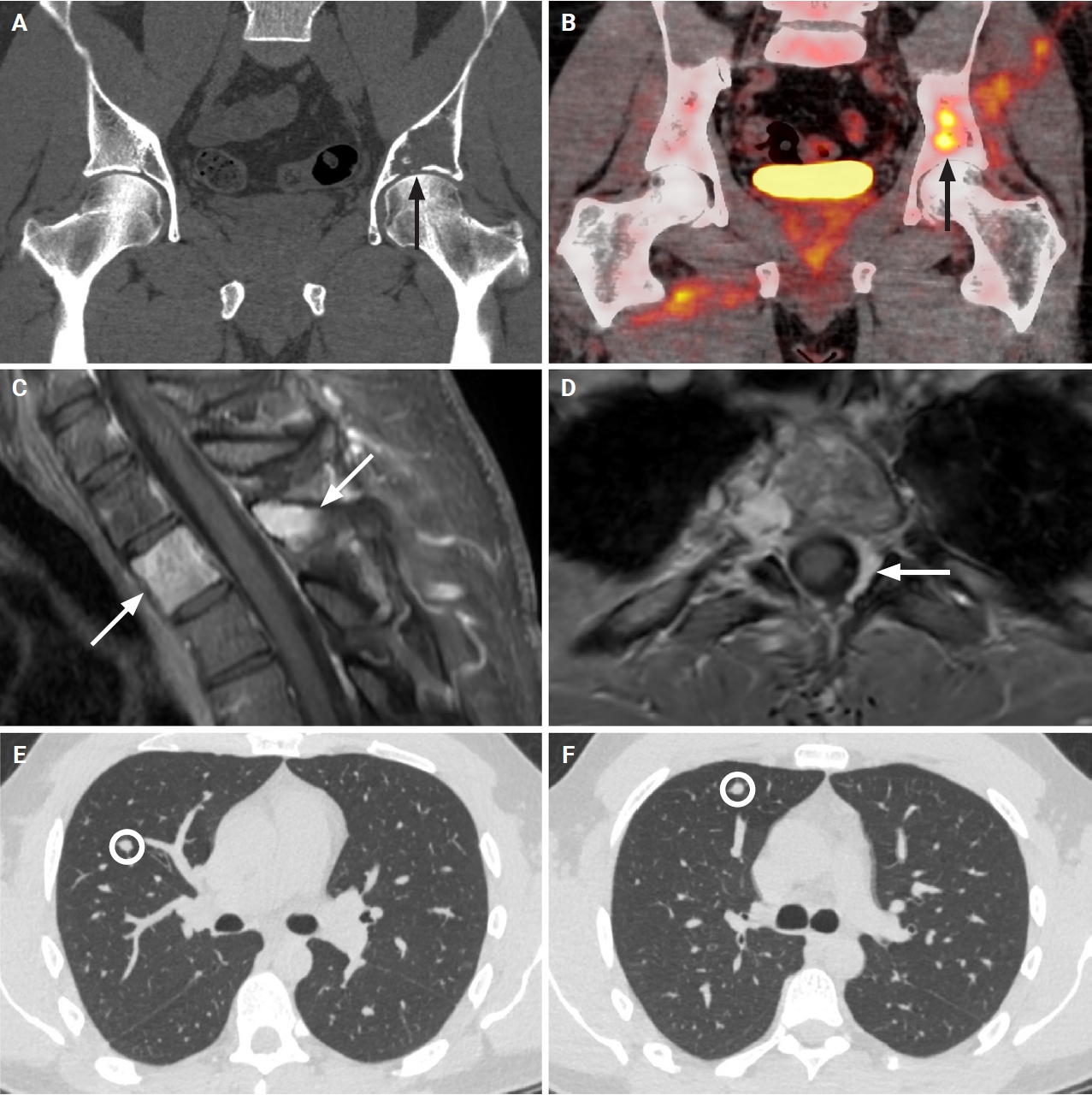
 - Low-grade fibro-osseous lesions can be challenging to classify. A 33-year-old man presented with synchronous lesions involving the ilium and T2 vertebra. Because of an impending pathologic fracture, he received several doses of denosumab. Initial biopsies showed bland fibro-osseous lesions lacking GNAS or MDM2 alterations and were favored to represent polyostotic fibrous dysplasia. Subsequent iliac curettage revealed a fascicular spindle cell proliferation with subtle atypia and focal ossification, leading to a revised diagnosis of low-grade fibrosarcoma. Re-biopsy of the T2 lesion demonstrated a similar spindle cell proliferation without ossification. Sequencing identified copy number gains involving KIT, PDGFRA, and TERT. At 16-month follow-up, two metastatic pulmonary nodules developed, one responsive to chemotherapy. The patient remains alive with disease at 27 months after presentation. This case highlights a diagnostic pitfall in which low-grade fibrosarcoma with denosumab-associated ossification may mimic fibrous dysplasia and underscores the prognostic value of molecular profiling beyond histologic grading.
Original Article
- The significance of papillary architecture in the follow-up biopsies of patients with progestin-treated atypical endometrial hyperplasia
- Wangpan J. Shi, Oluwole Fadare
- J Pathol Transl Med. 2026;60(1):58-68. Published online January 8, 2026
- DOI: https://doi.org/10.4132/jptm.2025.09.12
- 3,804 View
- 455 Download
-
Abstract
PDF
- Background
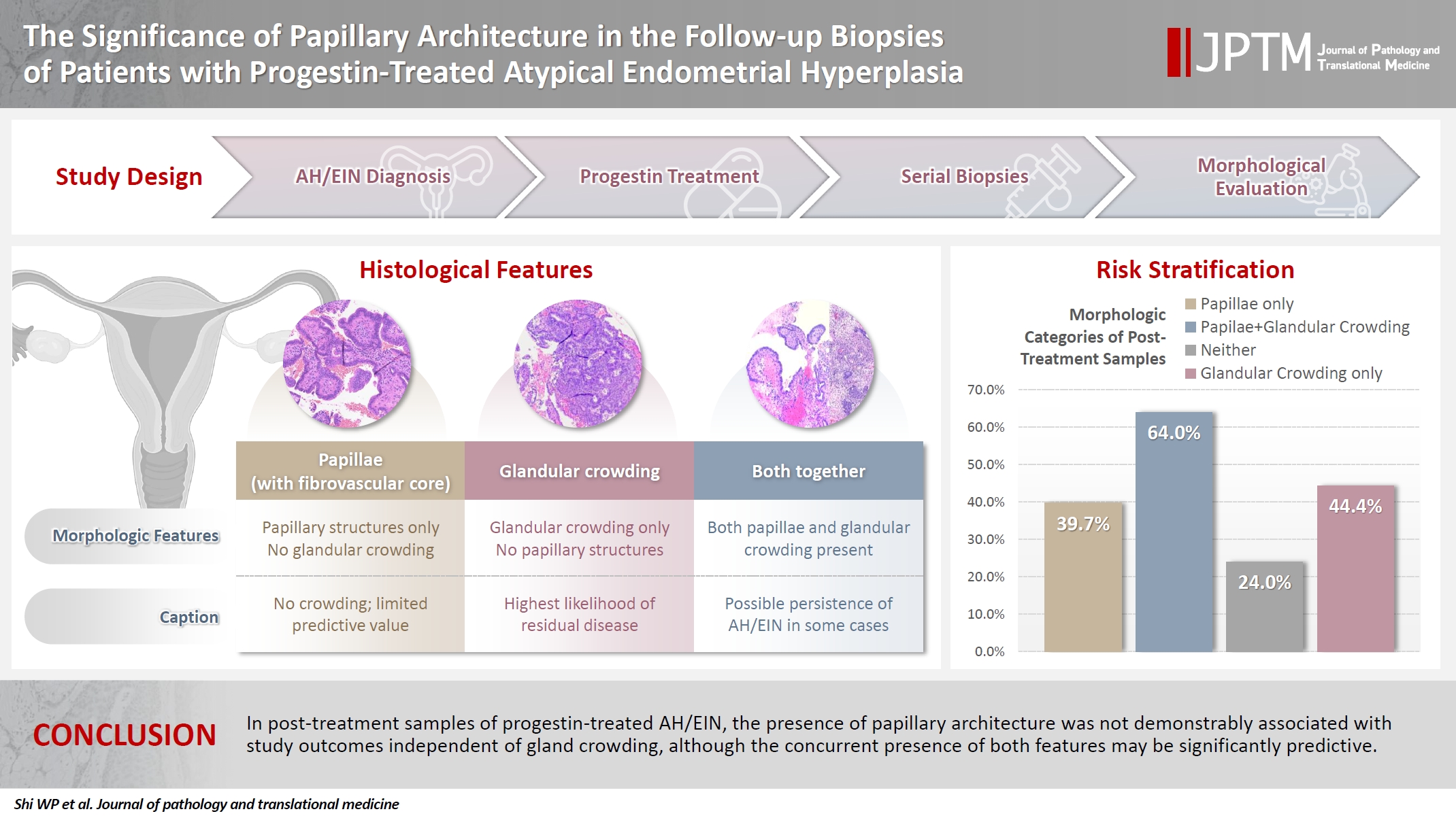
Follow-up biopsies in patients with progestin-treated atypical endometrial hyperplasia/endometrioid intraepithelial neoplasia (AH/EIN) may show papillary structures, the significance of which is unclear. Methods: The authors reviewed 253 serial specimens of 84 consecutive patients diagnosed with AH/EIN, inclusive of each patient's pre-progestin treatment sample and all post-treatment specimens. We assessed the predictive relationship between papillary architecture in a post-treatment biopsy and two study outcomes: AH/EIN or carcinoma in at least one sample subsequent to the one in which papillae were identified, and/or the last specimen received for that patient. Results: Papillae were identified in only 51.5% of pre-treatment samples but were present in at least one subsequent post-treatment sample for all patients. Post-treatment samples that exhibited papillae and no glandular crowding were associated with AH/EIN in at least one subsequent specimen in 39.7% (29/73) of cases, compared to 24.0% (6/25) in samples with neither papillae nor glandular crowding (p = .227) and 64.0% (16/25) in samples with concurrent gland crowding and papillae (p = .048). Univariate logistic regression analyses showed that the presence of papillae was not associated with study outcomes (odds ratio [OR], 0.99; 95% confidence interval [CI], 0.49 to 1.99; p = .985), as compared with gland crowding (OR, 1.54; 95% CI, 1.04 to 2.27; p = .031), or concurrent papillae and gland crowding (OR, 2.36; 95% CI, 1.01 to 5.52; p = .048). Conclusions: In post-treatment samples of progestin-treated AH/EIN, the presence of papillary architecture was not demonstrably associated with study outcomes independent of gland crowding, although the concurrent presence of both features may be significantly predictive.
 First
First Prev
Prev



