
 E-submission

Search
- Page Path
- HOME > Search
Original Article
- Prognostic value of PD-L1 combined positive score in colorectal adenocarcinoma
- Thi Thanh Xuan Le, Van Chu Nguyen, Thi Minh Hanh Ngo, Thi Hue Le, Minh Son Le, Huu Song Le, Xuan Hoan Nghiem
- J Pathol Transl Med. 2026;60(6):611-624. Published online November 13, 2026
- DOI: https://doi.org/10.4132/jptm.2026.08.24
- 90 View
- 3 Download
-
 Abstract
 PDF
 Supplementary Material
- Background
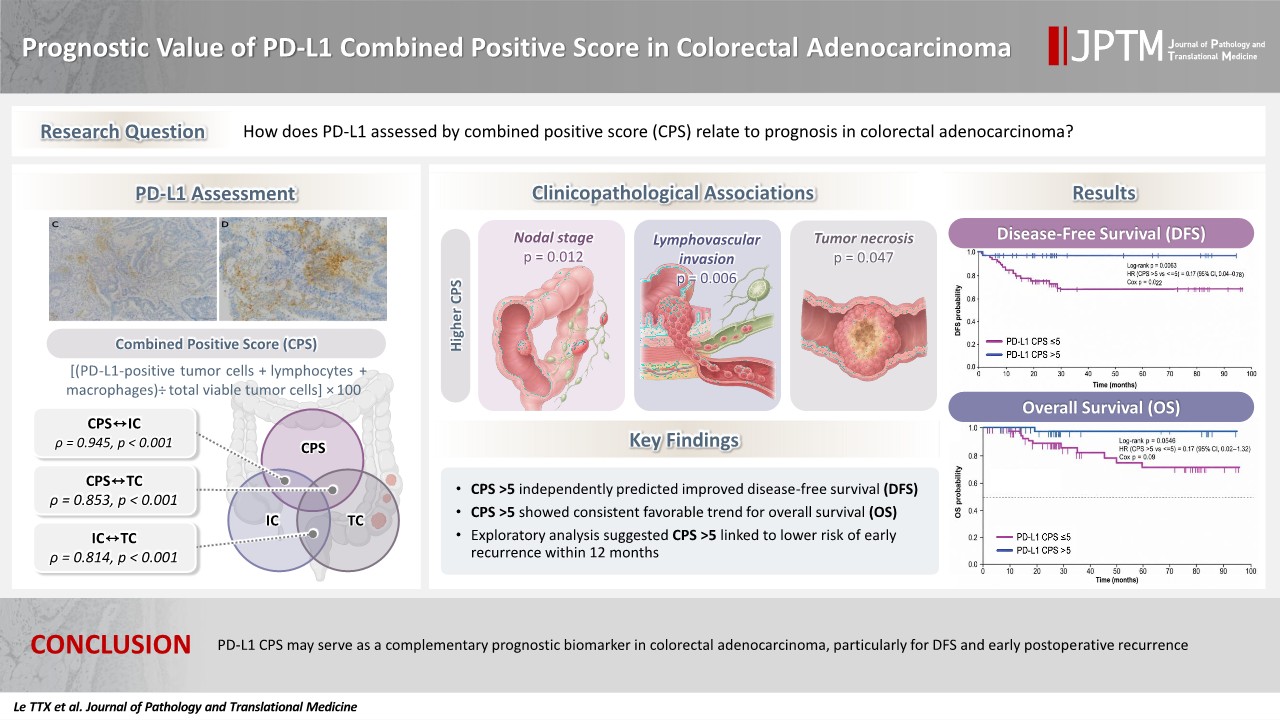
The prognostic significance of programmed cell death ligand 1 (PD-L1) in colorectal adenocarcinoma remains unclear. We evaluated the clinicopathological and prognostic relevance of the PD-L1 combined positive score (CPS). Methods: This single-center retrospective cohort included 124 patients with histopathologically confirmed colorectal adenocarcinoma; PD-L1 was assessed by CPS. Disease-free survival (DFS) and overall survival (OS) were evaluated using Kaplan-Meier methods and parsimonious Cox regression, and early recurrence within 12 months of curative-intent treatment with a truncated Cox model. Results: Higher CPS was significantly associated with nodal stage (p = .012), lymphovascular invasion (p = .006), and tumor necrosis (p = .047). CPS correlated very strongly with immune-cell PD-L1 (rho = 0.945, p < .001) and strongly with tumor-cell PD-L1 (rho = 0.853, p < .001). CPS >5 remained associated with favorable DFS in a prespecified parsimonious multivariable model (adjusted hazard ratio [HR], 0.17; 95% confidence interval [CI], 0.04 to 0.75; p = .019). No PD-L1 metric was significantly associated with OS; however, CPS showed a numerically favorable but non-significant trend (adjusted HR, 0.17; 95% CI, 0.02 to 1.30; p = .088). In the exploratory early recurrence analysis, CPS >5 was associated with a lower risk of early recurrence in a model adjusted only for nodal stage (adjusted HR, 0.21; 95% CI, 0.05 to 0.94; p = .042). Conclusions: PD-L1 CPS may serve as a complementary, hypothesis-generating prognostic marker in colorectal adenocarcinoma, particularly for disease-free survival. However, the lack of mismatch repair (MMR)/microsatellite instability (MSI) data prevents definitive conclusions regarding an MMR/MSI-independent prognostic effect. Further validation in larger, prospectively collected, multicenter cohorts with comprehensive molecular annotation is required.
 First
 Prev




