
 E-submission

Search
- Page Path
- HOME > Search
Original Articles
- Clinicopathological associations and prognostic significance of EZH2, H3K27me3, pRB, p53, and p16 expression in diffuse large B-cell lymphoma
- Ishan Gupta, Surabhi Jain, Moien Rasheed Lone, Ajay Gogia, Chandan Krushna Das, Mehar Chand Sharma, Ashish Datt Upadhyay, Saumyaranjan Mallick
- J Pathol Transl Med. 2026;60(6):635-645. Published online November 13, 2026
- DOI: https://doi.org/10.4132/jptm.2026.09.14
- 62 View
- 2 Download
-
 Abstract
 PDF
 Supplementary Material
- Background
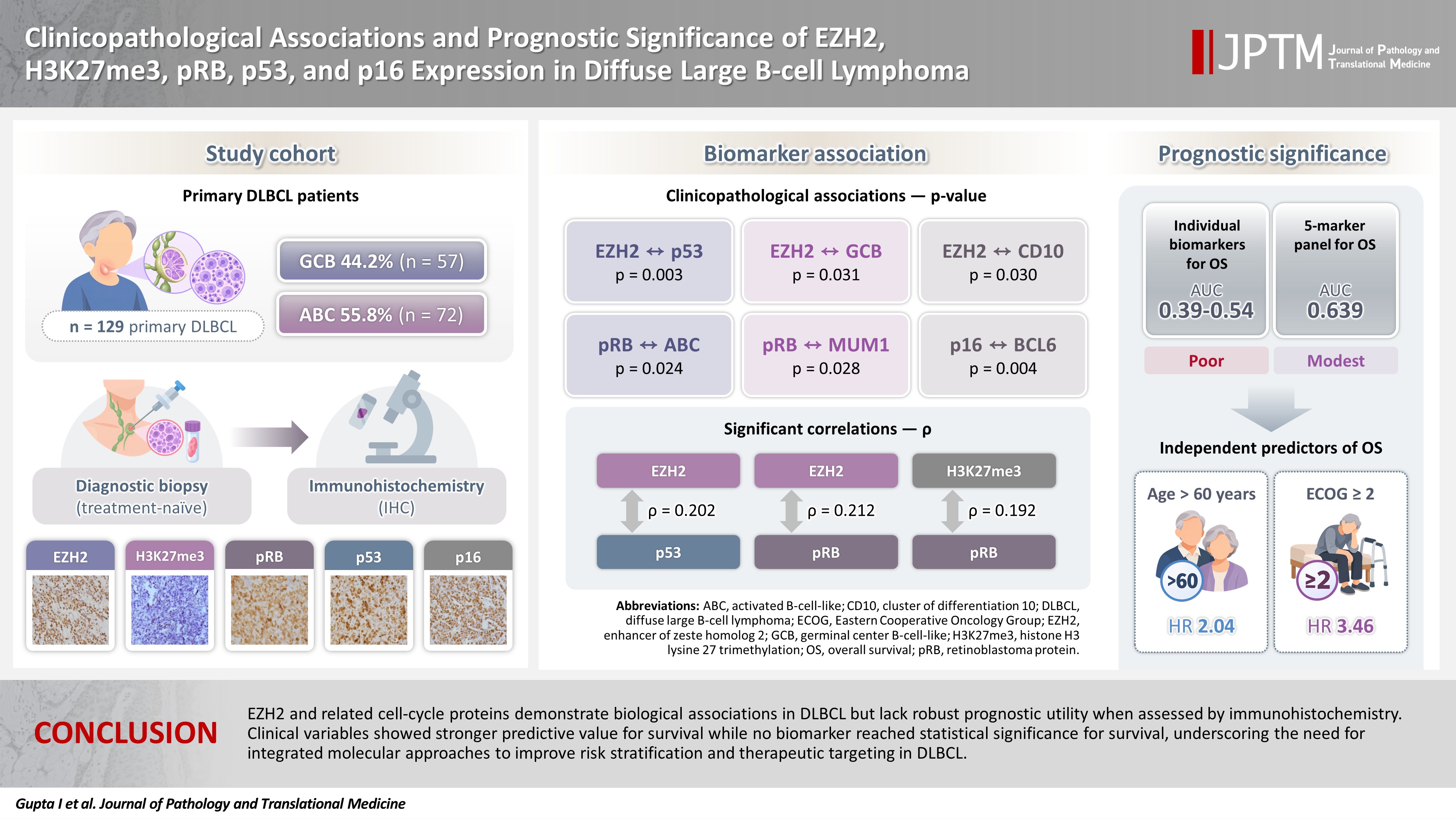
Diffuse large B-cell lymphoma (DLBCL) is characterized by pronounced heterogeneity in its morphological and biological attributes, with emerging evidence highlighting the pivotal role of epigenomic alterations in its pathogenesis. This study aimed to investigate the relationship between EZH2 expression and cell-cycle regulatory proteins, focusing on their prognostic implications. Methods: This retrospective study included 131 patients with nodal primary DLBCL, who were categorized according to the Hans algorithm and additional immunohistochemistry was performed for selected epigenetic (EZH2 and H3K27me3) and cell-cycle regulatory markers (phosphorylated retinoblastoma [pRB], p16 and p53). Receiver operating characteristic (ROC) curve analysis and Cox regression models were applied to assess prognostic utility. Appropriate statistical analysis was performed. Results: EZH2 was expressed in 59.5% of cases and significantly associated with p53 (p = .003), germinal center B-cell-like (GCB) subtype (p = .031), and CD10 positivity (p = .030). pRB positivity was more frequent in the activated B-cell-like subtype (82.5% vs. 64.3%, p = .024) and was associated with MUM1 (p = .028), while p16 expression was linked to BCL6 (p = .004). ROC analyses demonstrated poor discriminatory ability for overall survival (area under the curve, 0.39 to 0.54), with no clinically actionable cutoffs identified. Stepwise Cox regression identified age >60 years (hazard ratio [HR], 2.04; p = .042) and Eastern Cooperative Oncology Group ≥ 2 (HR, 3.46; p = .001) as independent predictors of overall survival. For progression-free survival, no biomarker reached statistical significance. Conclusions: EZH2 and related cell-cycle proteins demonstrate biological associations in DLBCL but lack robust prognostic utility when assessed by immunohistochemistry. Clinical variables showed stronger predictive value for survival, while no biomarker reached statistical significance for survival, underscoring the need for integrated molecular approaches to improve risk stratification and therapeutic targeting in DLBCL.
- Acid-Fastness of Histoplasma in Surgical Pathology Practice
- Madhu Rajeshwari, Immaculata Xess, Mehar Chand Sharma, Deepali Jain
- J Pathol Transl Med. 2017;51(5):482-487. Published online September 14, 2017
- DOI: https://doi.org/10.4132/jptm.2017.07.11

- 17,888 View
- 193 Download
- 11 Web of Science
- 10 Crossref
-
Abstract
PDF
- Background
Histoplasmosis (HP) is diagnosed by visualizing intracellular microorganisms in biopsy and/or culture. Periodic-acid Schiff (PAS) and Gomori methenamine silver (GMS) staining methods are routinely used for identification. The acid-fast property of Histoplasma was identified decades ago, but acid-fast staining has not been practiced in current surgical pathology. Awareness of the acid-fast property of Histoplasma, which is due to mycolic acid in the cell wall, is important in distinguishing Histoplasma from other infective microorganisms. Here, we examined acid-fastness in previously diagnosed cases of Histoplasma using the Ziehl-Neelsen (ZN) stain and correlated those findings with other known fungal stains. Methods: All cases diagnosed as HP were retrieved and reviewed along with ZN staining and other fungal stains. We also stained cases diagnosed with Cryptococcus and Leishmania as controls for comparison. Results: A total of 54 patients ranging in age from 11 to 69 years were examined. The most common sites of infection were the skin, adrenal tissue, and respiratory tract. Of the total 43 tissue samples, 20 (46.5%) stained positive with the ZN stain. In viable cases, a significant proportion of microorganisms were positive while necrotic cases showed only rare ZN-positive yeasts. In comparison to PAS and GMS stains, there was a low burden of ZN-positive yeasts. Cryptococcus showed characteristic ZN staining and all cases of Leishmania were negative. Conclusions: Although the morphology of fungal organisms is the foundation of identification, surgical pathologists should be aware of the acid-fast property of fungi, particularly when there is the potential for confusion with other infective organisms. -
Citations
Citations to this article as recorded by
-
Development of an
in situ
hybridization assay for the diagnosis of
Mycobacteriaceae
infections of veterinary importance
Agustín Rebollada-Merino, Sean P. McDonough, Francisco A. Uzal, Antonio Rodríguez-Bertos, Rodman G. Getchell, Shotaro Nakagun, Elena A. Demeter
Veterinary Pathology.2026; 63(2): 223. CrossRef - Disseminated histoplasmosis in an HIV/AIDS transgender male‐to‐female with atypical and persistent GI manifestations
Aaron C Yee, Sarah Huang, Ranbir Singh, Dean Rizzi, Naureen Shama, Neil Khoury, Ilan S Weisberg
JGH Open.2024;[Epub] CrossRef - Fungi that are medically relevant to humans and their prospect in a global warming scenario
Bernardo Franco, Naurú Idalia Vargas-Maya, Felipe Padilla-Vaca, Fátima Berenice Ramírez-Montiel, José Ascención Martínez-Álvarez
Academia Molecular Biology and Genomics.2024;[Epub] CrossRef - Emerging Fungal Infections and Cutaneous Manifestations in Immunosuppressed Patients
Jeffrey Alex Varghese, Samantha Guhan, Lida Zheng
Current Dermatology Reports.2023; 12(2): 69. CrossRef - Histoplasma capsulatum var. duboisii: A KwaZulu‐Natal, South Africa public sector perspective
Lerato Claudia Khathali, Gamalenkosi Bonginkosi Nhlonzi, Absalom Mwazha
Journal of Cutaneous Pathology.2022; 49(2): 139. CrossRef - Histologic features of colonic infections
Maria Westerhoff
Der Pathologe.2022; 43(1): 16. CrossRef - Challenge of Ziehl-Neelsen stain for Basidiobolomycosis diagnosis in Indonesia: A unique case report
Metta Octora, Arthur Pohan Kawilarang, Pepy Dwi Endraswari
Annals of Medicine and Surgery.2022; 74: 103278. CrossRef - Pulmonary Histoplasmosis Mimicking Metastatic Lung Cancer: A Case Report
Gion Ruegg, Stefan Zimmerli, Maria Trachsel, Sabina Berezowska, Swantje Engelbrecht, Yonas Martin, Martin Perrig
Diagnostics.2021; 11(2): 328. CrossRef - Cutaneous Histoplasmosis in HIV Seronegative Patients: A Clinicopathological Analysis
Arvind Ahuja, Minakshi Bhardwaj, Poojan Agarwal
Dermatology.2021; 237(6): 934. CrossRef - Challenges in the Diagnosis of Invasive Fungal Infections in Immunocompromised Hosts
Spinello Antinori, Mario Corbellino, Carlo Parravicini
Current Fungal Infection Reports.2018; 12(1): 12. CrossRef
-
Development of an
in situ
hybridization assay for the diagnosis of
Mycobacteriaceae
infections of veterinary importance
 First
 Prev




