
 E-submission

Search
- Page Path
- HOME > Search
Original Article
- Subclassification of the undifferentiated component in early gastric cancer: the poorly differentiated tubular adenocarcinoma component is associated with lymph node metastasis and local aggressiveness
- Heesoo Kim, Baek-hui Kim
- J Pathol Transl Med. 2026;60(6):646-656. Published online November 13, 2026
- DOI: https://doi.org/10.4132/jptm.2026.09.15
- 72 View
- 1 Download
-
 Abstract
 PDF
 Supplementary Material
- Background
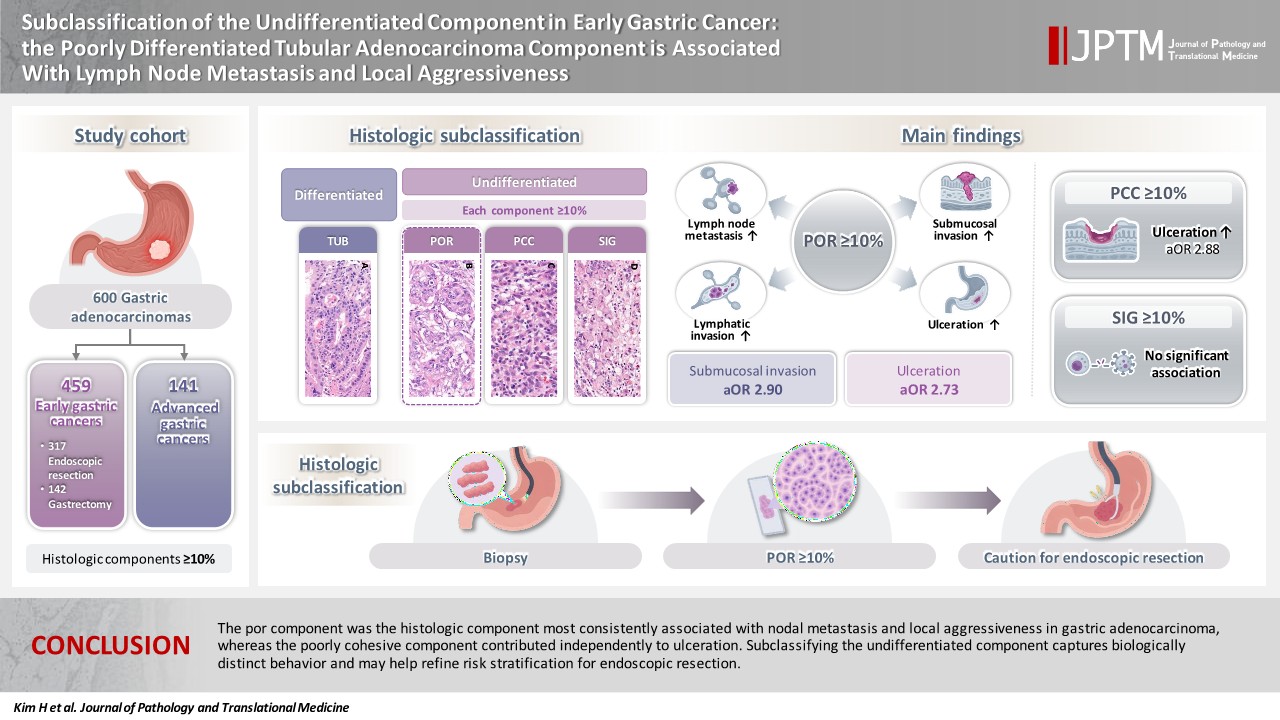
Gastric adenocarcinoma is histologically heterogeneous, and the undifferentiated category encompasses tubular adenocarcinoma, poorly differentiated (por), poorly cohesive carcinoma (pcc), and signet ring cell carcinoma (sig). These components are often treated as a single entity, and which one drives the aggressive behavior of mixed-type tumors remains unclear. We subclassified the undifferentiated component and examined the association of each histologic component with adverse pathologic features. Methods: We retrospectively analyzed 600 gastric adenocarcinomas (459 early, 141 advanced). Each histologic component (tub [tubular adenocarcinoma, well to moderately differentiated], por, pcc, sig) was assessed separately in the mucosal and invasive portions and dichotomized at 10%. Associations with lymph node metastasis (LNM), submucosal invasion, lymphatic invasion, and ulceration were evaluated by univariate testing and multivariable logistic regression. Results: In early gastric cancer, por ≥10% was associated with LNM (p = .006) and lymphatic invasion (p < .001), and was an independent risk factor for submucosal invasion (adjusted odds ratio [OR], 2.90; 95% confidence interval [CI], 1.80 to 4.68; p < .001) and ulceration (adjusted OR, 2.73; 95% CI, 1.40 to 5.34; p = .003). By contrast, pcc ≥10% was independently associated only with ulceration (adjusted OR, 2.88; 95% CI, 1.25 to 6.65; p = .013), and sig showed no association with any adverse feature (all p > .05). Findings in the mucosal component paralleled those in the whole tumor. No histologic component was associated with survival. Conclusions: The por component was the histologic component most consistently associated with nodal metastasis and local aggressiveness in gastric adenocarcinoma, whereas the poorly cohesive component contributed independently to ulceration. Subclassifying the undifferentiated component captures biologically distinct behavior and may help refine risk stratification for endoscopic resection.
 First
 Prev




