
 E-submission
Search
- Page Path
- HOME > Search
Case Study
- Unusual biclonal IgA plasma cell myeloma with aberrant expression of high-risk immunophenotypes: first report of a new diagnostic and clinical challenge
- Carlos A. Monroig-Rivera, Clara N. Finch Cruz
- J Pathol Transl Med. 2023;57(2):132-137. Published online March 14, 2023
- DOI: https://doi.org/10.4132/jptm.2023.02.07
- 7,394 View
- 146 Download
- 1 Web of Science
- 1 Crossref
-
 Abstract
 PDF
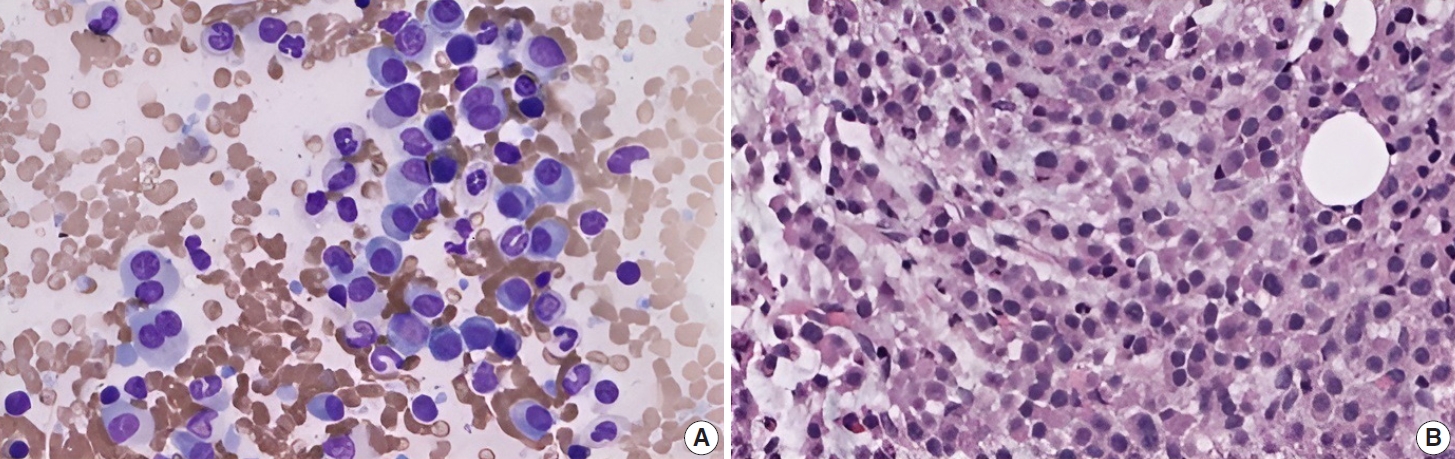
PDF - IgA plasma cell myeloma (PCM) has been linked to molecular abnormalities that confer a higher risk for adverse patient outcomes. However, since IgA PCM only accounts for approximately 20% of all PCM, there are very few reports on high-risk IgA PCM. Moreover, no such reports are found on the more infrequent biclonal IgA PCM. Hence, we present a 65-year-old Puerto Rican female with acute abdominal pain, concomitant hypercalcemia, and acute renal failure. Protein electrophoresis with immunofixation found high IgA levels and detected a biclonal IgA gammopathy with kappa specificity. Histomorphologically, bone marrow showed numerous abnormal plasma cells (32%) replacing over 50% of the marrow stroma. Immunophenotyping analysis detected CD45-negative plasma cells aberrantly expressing CD33, CD43, OCT-2, and c-MYC. Chromosomal analysis revealed multiple abnormalities including the gain of chromosome 1q. Thus, we report on an unusual biclonal IgA PCM and the importance of timely diagnosing aggressive plasma cell neoplasms.
-
Citations
Citations to this article as recorded by
- Extreme PTH-Independent Hypercalcemia Mediated by a Rare Non-Osteoclastic Osteolysis Mechanism in Newly Diagnosed High-Risk Biclonal IgA Multiple Myeloma: Temporal Association with the Second Dose of Moderna mRNA-1273 COVID-19 Vaccine
Clara N. Finch-Cruz, Serena I. Fazal, Vivianette Fuentes Morales
International Journal of Molecular Sciences.2026; 27(15): 6832. CrossRef
- Extreme PTH-Independent Hypercalcemia Mediated by a Rare Non-Osteoclastic Osteolysis Mechanism in Newly Diagnosed High-Risk Biclonal IgA Multiple Myeloma: Temporal Association with the Second Dose of Moderna mRNA-1273 COVID-19 Vaccine
Case Report
- Mesenteric Cystic Lymphangioma with Sustained Abdominal Pain : Report of a case.
- Gyeong Hoon Kang, Yong Il Kim, Woo Ho Kim, In Sung Song, Kyoo Wan Choi
- Korean J Pathol. 1991;25(5):488-490.
- 2,387 View
- 11 Download
-
Abstract
- A case of cystic lymphangioma of the mesentery with severe and persistent abdominal pain in a 22-year-old man is presented. The cyst was filled with chylous fluid. Microscopically, numerous nerve bundles were incorporated within the lymphangiomatous walls, and some protruded into the lumen. The above findings lead to a suggestion that mesenteric lymphangioma may differ from those in the other sites by its abundance of incorporation of nerve bundles into the lymphangiomatous walls, and that increase of tumor size by intracystic accumulation of chylous fluid may subsequently result in increase of intraluminal pressure to compress the nerve bundles with which abdominal pain is much enhanced.
 First
First Prev
Prev



